Iconoclasm is useful in church history to purge abuses of the arts but I think it ought to be the exception and not the rule, namely because it can tend to misplace our priorities. The worship of God is our highest calling as men and the character and setting of our worship reflects the greatness of God's glory. If secular music is the "best" and most cultivated music, then church music essentially lies about the character of God. Obviously there is a lot to be qualified in these statements, but simply put, plain worship poorly represents the great God it seeks to serve.
Tuesday, April 15, 2014
Puritans and Church Music
I have recently been reading Percy Scholes's Puritans and Music (OUP, 1934), a work that examine's the Puritan attitude toward music--an attitude that by no means condemned music in general, but rather served to elevate secular music as a noble pursuit. Through a series of essay-like chapters, Scholes convincingly makes a case for a high view of music and the arts among the English Puritans. Time and time again Scholes reiterates Puritan disapproval of instrumental and polyphonic music in church and in one chapter devoted entirely to the subject, he outlines various manifestations of this point of view in and outside of English Puritanism.

Thursday, March 20, 2014
Funny quote--Haydn's The Seasons
From Jacobs's Choral Music, page 169: "The Seasons (1801), Haydn's last major work, does not stand up to complete performance, partly because the recitatives grow wearisome as one's indifference to the fate of Jane, Lucas, and Simon increases."
Sunday, March 16, 2014
A Problem with Contemporary Worship Music
While trying to be relevant and contemporary-sounding, praise music falls sadly behind the pack of cultural progress and becomes irrelevant. New trends and fashions change continuously and are difficult to keep up with. Some may claim they are not trying to be cutting edge but are rather trying to do music in a style that the culture understands. But what does the culture understand and what sort of music has broad appeal that church people young , old, black, white, life-longers, new converts, and seekers can all appreciate? I suggest that contemporary worship music can't do what its proponents say it can.
A problem that plagues all art is the reality of context; that a work of art is tied to a point in time, and has particular audience in mind. The context of worship song is the worship service itself, while the context of contemporary praise music is popular music which is in constant change. For all its merits, this video to the writer sounds like post-grunge music that appealed to young white people back in the mid-1990s . (I may be hearing a trace of The Wall Flowers?) In such a case, how does invoking this music actually side track and distract from authentic worship? I say we must consider our music choices carefully, keeping the special character of worship in view. God does not share His glory with a competing god, and we must take care to make sure this doesn't happen when our music suggests something other than God's glory.
A problem that plagues all art is the reality of context; that a work of art is tied to a point in time, and has particular audience in mind. The context of worship song is the worship service itself, while the context of contemporary praise music is popular music which is in constant change. For all its merits, this video to the writer sounds like post-grunge music that appealed to young white people back in the mid-1990s . (I may be hearing a trace of The Wall Flowers?) In such a case, how does invoking this music actually side track and distract from authentic worship? I say we must consider our music choices carefully, keeping the special character of worship in view. God does not share His glory with a competing god, and we must take care to make sure this doesn't happen when our music suggests something other than God's glory.
Sunday, January 19, 2014
Hymn: O Love, How Deep, How Broad, How High
...have
strength to comprehend with all the saints what is the breadth and length and
height and depth and to know the love of Christ that surpasses knowledge… Eph.
3:17-19
These verses form the basis of the first stanza
of this hymn. The remaining stanzas describe the magnitude of Christ’s love in
His life, death, burial, resurrection, ascension, and in sending of the Holy
Spirit. Although it is primarily about
Christ, it acknowledges the full, Triune nature of God as it closes with a
paraphrase of the Gloria Patri (“Glory
be to the Father, and to the Son, and to the Holy Ghost, as it was…”).
The hymn text, in its original Latin, is often ascribed to Thomas à
Kempis, author of the devotional book The
Imitation of Christ.
The exuberant tune, DEO GRACIAS, was composed
shortly around 1415 when the English defeated the French at Agincourt in Normandy. The music was originally set to another text
thanking God for England’s
victory. The film score to Lawrence
Olivier’s Henry V, which retells the
famous battle, quotes this tune to stunning effect.
As you sing this rousing hymn, enjoy the jaunty,
dance-like rhythms of the music. The
music is a fitting match for the lofty, celebratory, Christ-centered text.
Sunday, January 05, 2014
Psalm 119:103-4
Here's another setting I recently completed of a couple verses from Psalm 119. Enjoy!


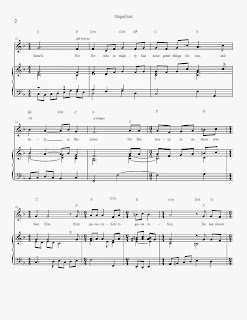
Setting of the Magnificat
Here's a new Magnificat setting I composed last summer. We've used it at our church with some success. Give it a whirl and let me know what you think.



Sunday, November 10, 2013
Genevan Psalm 124
Our help
is in the name of the Lord, who made heaven and earth.
(Psalm 124:8, ESV)
One
of the great benefits of the Reformation of the sixteenth century was the
recovery of congregational singing.
Luther, Reformer both of church doctrine and worship practice, believed
the pursuit of music was secondary only to the study of theology. Thus music flourished in Lutheran circles and
set a faithful precedent for other protestant churches. Calvinistic congregations took to singing
metrical psalms: psalms poetically paraphrased into the native tongue of the
local church. In the centuries following
the Reformation, Reformed churches sang only psalms, without harmony or
accompaniment. Yet, the simple and
unadorned music that originated in Calvin’s church in Geneva
saw widespread popularity throughout Europe. (Elizabeth I of England supposedly nicknamed the
jaunty tunes “Geneva Jigs.”)
The
music of the Genevan Psalter was composed and edited largely by Loys (Louis)
Bourgeois, composer of the tune ‘Old Hundredth’ (TH 1), commonly sung to the
Doxology text “Praise God from whom all blessings flow.” Within a few years, the Genevan Psalter was
the official hymnal of the Genevan church and was so highly regarded that the
Bourgeois himself was later arrested for altering the tunes. Unfortunately, this event forced him to turn
his back on the Genevan church and leave the city.
‘Old
124th’, another of Bourgeois’s tunes, was composed early in the
development of the Genevan Psalter and was carried to England and Scotland by the returning exiles
that had earlier fled the persecutions of Mary Tudor. Scottish Presbyterians in particular seem to
have latched on to this stirring psalm setting.
"Come Ye Thankful People, Come"
Those who sow in tears
shall reap with shouts of joy! He who goes out weeping, bearing the seed for
sowing, shall come home with shouts of joy, bringing his sheaves with him. (Ps. 126:6 ESV)
The
phrase “Harvest Home” describes the act of gathering grain from the fields into
the village for storage and refers a time of celebration and thanksgiving. Scripture often connects harvest with
rejoicing. In Ps. 126, for example, sowing
seed is a mournful deed in comparison to the peals of joy that accompany the
reaping of grain. Men rejoice at harvest,
relieved from the summer’s heat, the weeds and pests, and from anxiously praying
for rain.
Recalling
the Parable of the Wheat and the Tares in
Mt. 13, the hymn writer uses the grain harvest as a metaphor for the harvest of
the redeemed that shall yet occur in history.
The wholesome wheat and troublesome tares grow up together in the same
field, but at the harvest God separates the plants for storage or
destruction. Harvest is a day of
rejoicing because the grain is gathered into storage and the weeds have been
eradicated for all time.
The
hymn’s tune, ST. GEORGE’S, WINDSOR, is a majestic, almost regal
melody. The tune appropriately matches
this text of Christian experience: it is at once joyous, thankful, and
respectful of hardship that has been long endured. The name of the tune derives from the London church where
George Elvey was employed as organist.
The tune is easy to sing and remember because of recurring rhythmic and
melodic elements. Whereas it would be
easy for these motives to become tediously repetitive, Elvey has incorporated
enough variation to make the tune at once both memorable and interesting.
Saturday, September 05, 2009
The High Call to Worship
I lament an obvious lack of experience in music and singing in our culture. Nowhere is this lack more troubling than in our institutions of higher ed. It is shocking and appalling that college students in very good music programs read music so poorly. I sing in a college choral ensemble and our director recently commented to me on how poorly some of the students read notes.
The problem is not necessarily the fault of the singers themselves. They just simply haven't been taught to read notes. Again, the problem here is cultural. Our culture's pragmatism and desire for instant gratification have allowed the next generation of pro musicians and teachers to go without basic musicianship training. As mentioned before, part of this problem simply stems from worship. In worship we make a joyful noise unto God through song and this is something we do regularly and with purpose. Pragmatism has spoiled communal music-making in the schools, turning an exercise that in itself is worthwhile into concert preparation: "kids, we've got to learn these 8 songs for our holiday concert in December. Ready,...altos..." The kids learn their notes by rote and learn very little about personal responsibility and skill. On the other had, weekly worship is a performance before the Almighty, not a rehearsal, and the purpose and object of worship is worthy and true. So the church's music making is better than the world's, because 1. we have more "concerts" and, 2. our goal is divine.
But do we in the church think of worship as a performance, and what are we doing to prepare ourselves and our kids for hearty praise each Sunday? If nothing, we are no better than the heathen who do what they have to do prepare for the concert.
Sunday, August 30, 2009
The pastures are clothed with flocks; the valleys also are covered over with corn; they shout for joy, they also sing. (Psalm 65:13)
This verse supports the medieval notion that creation is ordered much like a piece of music. The order and harmony of the earth itself sings God’s praise. In Paul’s language, God’s invisible attributes are known from the things made. Our songs then should reflect the harmony of the Godhead, the wisdom of God in creation, and strive remind us of God’s manifold attributes.
Tuesday, August 11, 2009
Problems that Face Reforming Singing in Worship
In our church community in Moscow, Idaho we speak a lot about the importance of hearty singing in worship. The way I've said it is that in many churches singing is one of the few really active things the congregation does in the service. It thus behooves us to sing well. Yet in our culture there are many obstacles to this goal. We live in a narcissistic age when comfort, ease, and pleasure seem to be man's "chief end." To the evangelical and world-ling alike the reality of sensuous entertainment in our lives has made us a culture of spectators, a right that in past ages belonged only to those of the highest social cast. We sit around like a bunch of nobles with our courtly entertainers parading before us in sensational splendor. In a sense we have more power than they of old, because we have electronic buttons and dials. In a digital age everything is tidy: no booing is necessary.
Instantaneous entertainment has made us flabby. Robust singing in worship would have not been a stretch to our lower and middle-class forefathers because it was simply part of their culture. Singing was a form of entertainment and a way of easing the drudgery of hard labor. In our time we let others do the singing for us in our leisure time and over the radio while we paint the trim. So if we would sing well in worship, we must first sing everywhere else.
Saturday, August 08, 2009
Didactic Singing
It has been said that preaching should comfort the afflicted and afflict the comfortable. Music in God's worship ideally will do a similar thing. As we sing God's praises we are reminded of the protection and Fatherly care we receive from God (Psalm 91) as well the seriousness of sin (Psalm 51) and importance of righteousness (Psalm 15). From the references in Ephesians and Colossians we know that singing is a means of teaching and correcting one another. This is consistent with the view that the book of Psalms in addition to being "the prayers of David" are a microcosm of the entire canon of scripture: we learn the Bible as we sing the psalms and therefore teach each other through singing.
Just what form this takes requires study and reflection and will inevitably lead to some liturgical reform. The fact is that the metrical psalms we sing in our Reformed churches aren't set up well for "teaching and admonishing one another," for in Hebrew poetry the natural dialogue that occurs structurally is downplayed in metrical settings. The didactic element of singing Paul talks about is likely the physical and spacial performance of the parallel phrase structure in the psalms. Early Christians would have been familiar with this method of singing from what was done in Jewish worship. In singing to each other (i.e. Dec. and Can.) we tangibly "discern the body" similarly as when taking the Supper.
Thursday, June 19, 2008
Review
Singing and Making Music
Paul S. Jones
PhillipsburgNJ
Paul Jones’s Singing and Making Music published by P&R is a diverse collection of essays on church music. Various topics Jones considers are payment of church musicians, the role and qualifications of church musicians, church music in small churches, the role of the accompanist in worship; ascriptions in the psalms, hymn writing, congregational singing, children’s music programs, and Martin Luther and Bar songs, to name just a few. Although this book doesn’t strive to be a comprehensive theology of music it examines a lot of the practical out-workings of a solidly Biblical foundation for music.
Singing and Making Music
Paul S. Jones
Phillipsburg
Paul Jones’s Singing and Making Music published by P&R is a diverse collection of essays on church music. Various topics Jones considers are payment of church musicians, the role and qualifications of church musicians, church music in small churches, the role of the accompanist in worship; ascriptions in the psalms, hymn writing, congregational singing, children’s music programs, and Martin Luther and Bar songs, to name just a few. Although this book doesn’t strive to be a comprehensive theology of music it examines a lot of the practical out-workings of a solidly Biblical foundation for music.
Tuesday, June 03, 2008
Cantus Christi in Recordings, II
Another recording I recently discovered that contains selections also found in the Cantus Christi is a recording of Genevan Psalms sung in Japanese (of all things), performed by Masaaki Suzuki and the Bach Collegium Japan. I just got this in the mail yesterday and my wife and I listened to this as we were drifting off to sleep last night.
It's a really great CD. It contains versions of Genevan Psalms harmonized in four parts by Goudimel, in viruostic solo settings for recorder by van Eyck, in variation settings for organ by Sweelinck, and lute settings by Vallet. Many of the psalms are sung in unison accompanied from the organ by Masaaki Suzuki, the founder and conductor of the BCJ. (Suzuki is a member of the Tokyo-oncho Reformed Church.) I presume that Suzuki provides many of these wonderful arrangements himself.
For those unfamiliar with the BCJ they are a group of the highest merit and performance quality. I have a couple of their recordings of Baroque sacred music, one of which is their recording of Messiah. Their Messiah recording has received high marks and I agree that it is wonderfully performed. The BCJ is known for its recordings of Bach's Church Cantatas on the BIS label. These are also fantastic.
High-points on the Psalm disc are the elaborate and moving exploration of Psalm 36, the rustic and energetic rendition of Psalm 47, complete with hand clapping, and the awesome variation on Psalm 118 for solo recorder. This disc is well worth the money for anyone familiar with the Genevan Psalms. The fact that the pieces are sung in Japanese should not scare anyone off. Other recordings I've mentioned are sung in French,...so?
Of the fifteen Psalms on the disc ten are also found in the Cantus Christi. Cantus singers are encouraged get copies of it.
Enjoy!
Monday, June 02, 2008
Church Music as a Genre, II
One reason we need to think of church music as its own thing has to do with its distinctive sound. Psalm 92 v. 3 commands praise upon a harp "with a solemn sound." It is this solemnity of sound that makes church music sound the way it does, distinguishing it from other genres.
What does solemnity mean? I think it means what most of us think of when solemn church music is heard or mentioned. It does not mean the music is always quiet or controlled as most would the define the word itself (think Geneva Jigs). But the music must be fitting for the praise the Most High. Good church music is often loud and can be energetic. The bottom line is that it is to be solemn in a way that is fitting for worship of our Holy God.
Other kinds of music entertain and divert. Some music is even profound. Church music is not any of these although there is sometimes overlap.
Monday, April 21, 2008
Cantus Christi Selections in Recordings
Those unfamiliar with many of the selections in the Cantus Christi hymnal would be helped by acquiring some recordings of the psalms and hymns in the book. Below is a basic list of recordings. Over the coming months (and years) I hope to include some commentary on the common selections with the Cantus. Links to the recordings on Amazon.com are included. Some of these can be downloaded directly from there. The Cantus numbers listed be low are page numbers.
1. Tallis, Archbishop Parker's Psalter Selections, Cantus Christi nos. 92, 93, 218, 372, & 377
2. Tallis, Dorian Service Selections, Cantus Christi nos. 126, 386, 392, 393, 396, 398, 406, 410, 413, 416, 420, 425, 426, & 430
Comment: This recording is a download and includes the selections from Archbishops Parker's Psalter listed under #1. Both recordings are very fine although the Tallis Scholars are especially fantastic.
3. Vaughn Williams, Hymns, Cantus Christi nos. 31, 66 (100), 154 (206), 214, 272 (288), 278, 280, 294, 301, 369, & 378
Not all the tunes listed are Vaughn Williams own arrangements. Vaughn Williams arranged a whole variety of sturdy and memorable tunes for the English Hymnal of 1906.
4. Scottish Psalter Selections, Cantus Christi nos. 38, 78, 84, 105, 134, 139, 144, 159, 162, 167, 193, 298, & 360
It appears that copies are only available from independent sellers. This is a nice disc. I hope its availability doesn't disappear.
5. Anglo-American Psalmody, Cantus Christi nos. 160, 266, 370, 382
This popular album, originally released under the title 'Goostly Psalms' hardly needs mention. There is some fun and unusual music on it. The first eight or so tracks are fantastic.
6. Genevan Psalms, Cantus Christi nos. 15, 36, 58, 72, 178.
The performances on this CD are all first rate. The Cantus numbers noted above are found in homophonic settings on the CD with the melody in the tenor. There are polyphonic settings on the CD of other Cantus selections but the tunes are harder to hear as they have been elaborated upon in such settings.
7. More Genevan Psalms, Cantus Christi nos. 15, 42, 58, 168, 178, 425
This CD I recommend with reservations. The arrangements of the psalms are interesting in that they feature Goudimel's several styles of psalm settings including monophonic, homophonic, and polyphonic. The listener gets a good idea of the breadth of Genevan psalm styles. But the performances themselves aren't great making this CD non-easy listening.
8. Lutheran Music, Cantus Christi nos. 208, 225, 231, 232, 404, 408
This CD is another interesting study in Reformation music particularly because it pits the rich polyphonic music of the conservatives Luther and Walter against the simple music of the radical, Thomas Muentzer. Walter's polyphony is thick and being that the hymn tune is in the tenor voice most of the pieces won't sound recognizable. Nevertheless, this is a CD worth having, if for no other reason than blasting on Reformation Sunday.
Wednesday, April 16, 2008
Book Review:
Church Music in History and Practice by Winfred Douglas
revised by Leonard Ellinwood
Scribner's, 1962
note: the original edition of this book was published in the 1930's. References to The Hymnal, 1940 are Ellinwood's.
Canon Winfred Douglas has written a thorough and very helpful book on church music and its use in liturgy. It is indeed a foundational work for those wanting the "what's what" in liturical music. Douglas, a devoted Episcopalian, shows his true colors a number of times in the book. This blog has already highlighted a couple of these. Many a recovering low-churchman will be further enticed by his rhetoric. Yet, at the same time, Douglas is very ecumenical (if the reader permits the term). He expresses a great debt of gratitude to guys who have broad, evangelical appeal like Luther, Bourgeois, Watts, Newton, and Wesley. This is not a book that dwells in the remote past, although much value is placed there. On pages 199-200 he digresses into a discussion of the meaning of the word "catholic." Briefly, he says "...all who praise [Christ] may be catholic members indeed. No mere being a high churchman of a low churchman of a broad churchman, an Episcopalian or a Roman Catholic, a Baptist, a Methodist or a Presbyterian, can give us a right to that lofty name." Whereas there is room to take exception with this statement if too broadly applied, Douglas, whose apparent audience is Episcopalians and Anglicans, strengthens his argument by drawing others in.
Douglas was a high churchman, to be sure, valuing the bells and whistles of elaborate liturgy. At the same he was appalled by the state of the modern Episcopal church's worship, where congregations were made mere spectators to the drama. We who favor sturdy congregational singing find an ally here. Douglas frequently speaks in pastoral tones in his book, desiring a music of God's people, not merely aesthetics.
It could be said that this book is a commentary on The Hymnal, 1940, of which Douglas is listed among the editors. Those unfamiliar with the music Douglas mentions in his book will find a The Hymnal a supplement to Douglas (indeed, Douglas a handbook to the Hymnal). The Hymnal, 1940 is an outstanding piece of practical scholarship as Douglas's book well demonstrates.
Wednesday, April 09, 2008
Winfred Douglas on the Psalms
“Few churches sing the Psalms at all. Fewer follow any order which insures the regular use of the entire Psalter…I know of at least one small country church where for years the daily Evensong Psalter has been sung through every month, and the Matins Psalter read. A certain degree of adaptability to conditions, of reasonable flexibility is good but the permissions granted in the rubric have further worked out disastrously in our Offices. Not only our people but some of our clergy, are slowly losing any spiritual knowledge of the Psalter as a whole. The spiritual knowledge has, in every age, been the main sustainer of the soul of man apart from the sacraments and prayer, and the vehicle of the praise of God even in the sacraments.”
What a sorry state of affairs. Douglas wrote this back in the 30's. We Presbyterians should be ashamed; we who claim to value the psalms so highly. Even if we don't revive the daily office we'd be doing well if we had regular contact with the psalms.Friday, April 04, 2008
Psalm 96:1-4
O sing unto the LORD a new song: sing unto the LORD, all the earth. Sing unto the LORD, bless His name; shew forth His salvation from day to day. Declare His glory among the heathen, His wonders among all people. For the LORD is great, and greatly to be praised: He is to be feared above all gods.
Here we are exhorted to sing a new song. A less-evident understanding holds that old songs are to be sung as if they are new, in a fresh and winsome way. But the more obvious meaning certainly applies. During David’s and Solomon’s times lots of brand new songs were sung. We continue to sing new songs unto God because His mercies are “new every morning.” God has not ceased to be faithful when He granted us salvation but continues to save us and provide for our every need. Therefore new praise is necessary: “…shew forth His salvation from day to day.”
Psalm 95:1-3
O come, let us sing unto the LORD: let us make a joyful noise to the rock of our salvation. Let us come before His presence with thanksgiving, and make a joyful noise unto Him with psalms. For the LORD is a great God and a great King above all gods.
Singing is a fitting act of worship. Worship of God requires a joyful spirit that pours out praise. Praise is a worthy sacrifice. Blood is necessary in so much that our flesh and blood are to be living sacrifices to God. Part of what it means to present our bodies living sacrifices is to praise God in singing.
Subscribe to:
Posts (Atom)